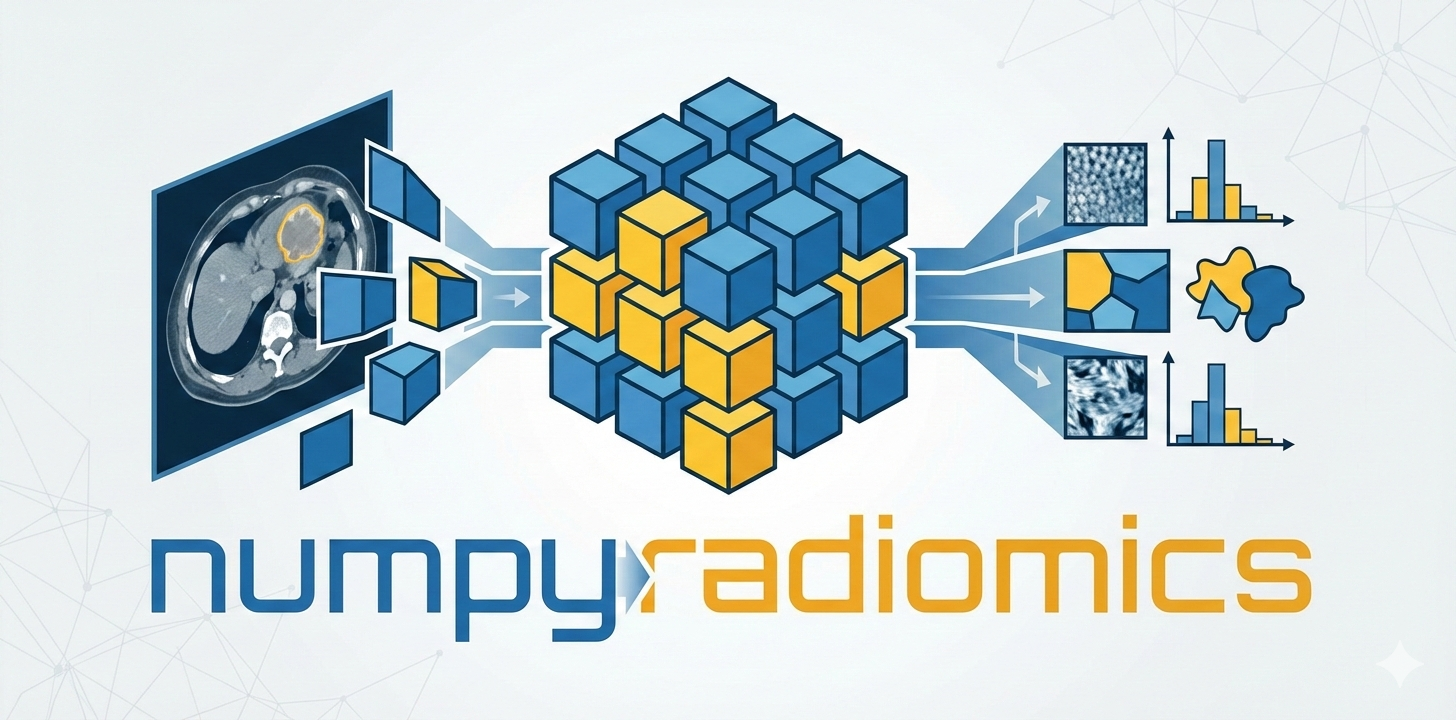
NumpyRadiomics#
A lightweight, pure-Python implementation of radiomic shape and
texture features, fully compatible with PyRadiomics definitions.
Built on top
of numpy, scipy, and skimage to minimize heavy dependencies
while maintaining accuracy.
Features#
Standard Compliance: Implements the official PyRadiomics definitions for texture and shape features.
Lightweight: No heavy C++ extensions or SimpleITK dependencies required—just standard scientific Python stacks.
Installation#
pip install numpyradiomics
Supported Features#
3D Shape (Standard)#
Volume: Mesh Volume, Voxel Volume
Surface: Surface Area, Surface-to-Volume Ratio
Dimensions: Max 3D Diameter, Max 2D Diameter (Slice, Column, Row)
Shape Descriptors: Sphericity, Elongation, Flatness
Axes: Major, Minor, and Least Axis Lengths
3D Shape (Extended)#
Advanced Volume: Convex Hull Volume, Bounding Box Volume
Ratios: Solidity, Extent
Inertia: Moments of Inertia, Fractional Anisotropy
Other: Maximum Depth (Chebyshev Radius), Longest Caliper Diameter
2D Shape#
Area: Mesh Surface, Pixel Surface
Perimeter: Perimeter, Perimeter-Surface Ratio
Shape Descriptors: Sphericity, Spherical Disproportion, Elongation
Axes: Major Axis, Minor Axis, Max Diameter
Texture#
All standard texture metrics are available:
GLCM: Gray Level Co-occurrence Matrix
GLRLM: Gray Level Run Length Matrix
GLSZM: Gray Level Size Zone Matrix
GLDM: Gray Level Dependence Matrix
NGTDM: Neighbouring Gray Tone Difference Matrix
License#
Apache 2.0 License